 Aujaswa
Acupuncture Wellness Clinic
Pain Management
Aujaswa
Acupuncture Wellness Clinic
Pain Management
Aujaswa
Acupuncture Wellness Clinic
Pain Management
Aujaswa
Acupuncture Wellness Clinic
Pain Management
Aujaswa was founded on a simple belief — the body already knows how to heal. Our work is to support that process, gently and consistently.
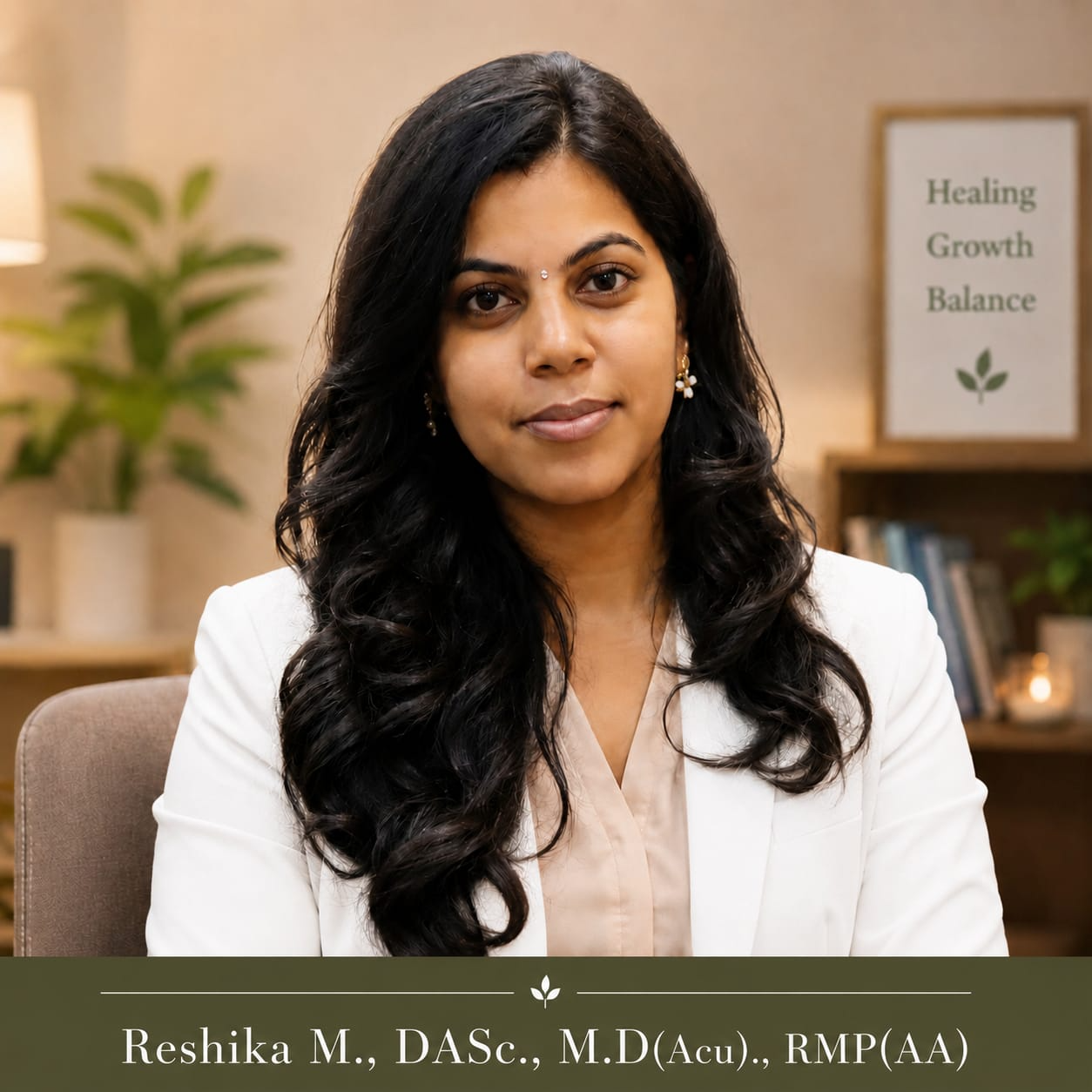
Reshika M is an acupuncture therapist practicing in Chennai, focused on helping patients manage chronic pain, ease stress and anxiety, and improve their overall sense of wellbeing. She combines traditional needle and touch therapies with a careful, patient-first consultation process — building a treatment plan around each individual rather than a one-size-fits-all protocol.
Every new patient begins with a detailed discussion of their health history and concerns, so that the right combination of therapies — acupuncture, electro-acupuncture, moxibustion, seed therapy or cupping — can be chosen for them.
Reshika M's approach is built on patience and observation — taking the time to understand each person before recommending a course of therapy, and adjusting that plan as your body responds over time. The goal in every session is simply to support your body's own process, one visit at a time.
Reg. No. 0131102578/20
No two patients are alike — every plan starts with understanding your specific history and symptoms.
Symptoms are signals. We aim to address the underlying imbalance, not just mask the discomfort.
Healing is a process. We track progress across sessions and adjust the plan as your body responds.

Acupuncture has been practised for over 2,500 years and traces its origins to ancient China. The earliest written records describing the insertion of needles at specific body points to support health date to the Han Dynasty (around 200 BCE), with the practice refined and systematised over subsequent centuries across East Asia. It spread more widely to the West during the 20th century and is now practised in many countries as a complementary approach to general wellbeing — often alongside conventional medicine rather than in place of it.
In traditional practice, acupuncture is understood through the concept of qi (pronounced "chi") — the body's vital energy, which flows through pathways called meridians. When this flow is disrupted, symptoms are thought to arise. Needling specific points along these pathways is traditionally used to restore balance. From a contemporary perspective, research suggests that stimulating acupuncture points may influence nerve signalling, local circulation, and the body's release of natural pain-modulating compounds. Most practitioners today draw on both frameworks — the classical understanding of pathways and the emerging physiological evidence — without treating them as contradictory.